10% OF EVERY PURCHASE IS DONATED TO SPECIAL OLYMPICS & SPECIAL NEEDS HOCKEY

How to Encourage Creativity Without Adding Pressure
Tale Tailor
2/17/20267 min read
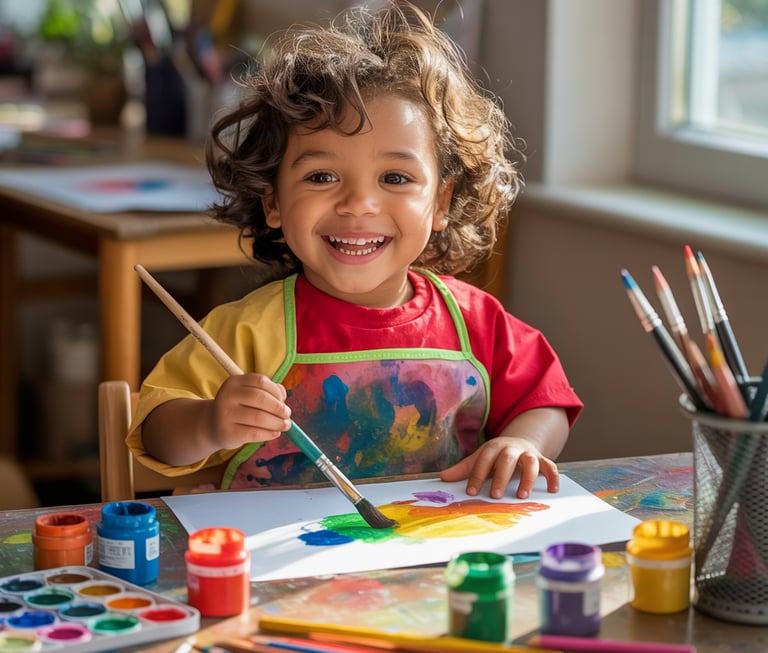
I bought my kids a fancy art kit. You know the kind—expensive markers, specialty paper, instructional guides for creating "masterpieces." I had visions of them creating beautiful artwork I could frame and display.
Instead, my daughter cried because her tree "didn't look right," and my son used the $40 watercolor set to paint rocks he found in the yard and then left them outside where they got rained on.
That's when I realized: I'd turned creativity into a performance. Into something that needed to look good, be Instagram-worthy, justify the cost of materials. I'd sucked all the joy right out of it.
The Creativity Paradox We're All Stuck In
We want our kids to be creative. We know creativity builds problem-solving skills, emotional intelligence, and resilience. Research from the University of Cambridge shows that creative activities significantly improve children's mental health, self-expression, and cognitive flexibility.
But somewhere along the way, we made creativity into another achievement to unlock. Another box to check. Another way kids could either succeed or fail.
The pressure to foster creativity is actually killing creativity. How's that for irony?
What Happens When Creativity Gets Complicated
I have a friend who signed her daughter up for art classes, music lessons, drama camp, and pottery workshops—all before the kid was seven. When I asked why, she said, "I just want to expose her to everything creative so she can find her thing."
Here's what happened: the daughter now refuses to draw or paint at home. She says she's "not good at it" unless a teacher tells her what to do. Creativity became something that happens in scheduled blocks, with instruction, with correct outcomes.
That's not creativity. That's compliance.
Child development expert Dr. Peter Gray, who studies the importance of play, found that unstructured creative time has declined 71% since the 1980s. Kids have less time to just mess around with materials, experiment, create for the sake of creating. Everything has become structured, measured, evaluated.
No wonder kids are anxious about trying new things.
What Real Creativity Looks Like (It's Messier Than You Think)
My son's creative process involves:
Getting out every single art supply we own
Spreading them across three rooms
Starting four different projects
Finishing none of them
Leaving glitter in places glitter should never be
Being incredibly proud of something that looks like a blob with googly eyes
And you know what? That's perfect. That's what creativity is supposed to look like when you're eight. It's exploration, not exhibition.
Practical Ways to Spark Creativity Without the Pressure
1. Create a "Messy Space" with No Rules
Set up a corner, a box, a drawer—anywhere—with basic supplies where kids can create whatever they want. The only rule: no rules.
Stock it with:
Cheap paper (the back of junk mail works great)
Crayons, markers, pencils (not the expensive ones)
Tape, glue, scissors
Cardboard boxes, egg cartons, toilet paper rolls
Random objects: buttons, fabric scraps, popsicle sticks
Play-dough (homemade is cheap and just as good)
The mindset shift: This isn't about creating art for display. It's about process, not product. If they make something and immediately crumple it up? That's fine. They were creating.
2. Stop Asking "What Is It?"
This is a game-changer. When kids show you something they've made, resist the urge to identify it.
Instead of: "Oh, what a nice... um... is that a dog?"
Try: "Tell me about what you made!" or "What was your favorite part about making this?"
This shifts the focus from the outcome (which they might feel insecure about) to the experience. It tells them that the doing matters more than the result.
3. Embrace Open-Ended Activities
The best creative activities have no predetermined outcome. Think less "paint this birdhouse following these instructions" and more "here are some materials, go wild."
Ideas that work:
Cardboard construction: Save Amazon boxes. Give them tape. Walk away. Kids will build entire civilizations.
Nature art: Collect sticks, leaves, rocks. Arrange them. Make patterns. No glue, no permanence. It's art that disappears, which removes all pressure.
Story stones: Paint rocks with simple images. Pull a few out and make up stories. Creativity meets storytelling.
Dance parties: Put on music. Move however feels right. No choreography, no "right" moves. Pure expression.
Shadow play: Flashlight + wall + hands = endless entertainment and creative storytelling
4. Model Imperfect Creativity
Kids need to see adults creating imperfectly.
I started doodling while my kids did homework. Not good doodles—weird, wonky doodles. My daughter asked what I was drawing, and I said, "I have no idea. I'm just making shapes."
She stared at me. "You don't have to make it look like something?"
"Nope."
The next day, she filled three pages with "abstract art" (her words). She wasn't worried about it looking right because she'd seen me not worry about it either.
Try this: Create alongside your kids. Make it clear you're experimenting, not performing. Say things like "I'm going to try something and see what happens" or "This didn't turn out how I thought, but that's okay."
5. Celebrate the Weird
My son made a "sculpture" out of plastic bottles, twist-ties, and one of his sister's hair clips (unauthorized). It was bizarre. It served no purpose. It was also the most creative thing he'd made in months.
I didn't understand it, but I celebrated it. "You really figured out how to balance all those pieces! How did you get it to stand up?"
When we celebrate the strange, the imperfect, the experimental, we tell kids: Your imagination is valuable exactly as it is.
6. Limit the "Classes" (Sometimes)
I'm not anti-lessons. If your kid loves piano or painting class, great. But be honest about why they're enrolled. Is it because they asked for it, or because you think they should be developing creative skills?
Research from Boston College found that kids with less structured time are better at self-directed creativity and executive function. Sometimes the best gift we can give them is a boring afternoon with nothing to do.
Boredom is the birthplace of creativity. When kids say "I'm bored," resist the urge to fix it. Say, "Boring is when your brain is getting ready to imagine something cool. Give it a few minutes."
Activities That Spark Joy (Not Performance Anxiety)
For Younger Kids (Ages 3-7):
Sensory bins: Fill a container with rice, beans, water beads, whatever. Add scoops, cups, toys. Let them pour, mix, create. It's messy. It's perfect.
Outdoor art: Sidewalk chalk, painting rocks, making mud pies. Nature is the ultimate permission to be imperfect.
Dress-up and pretend play: Old clothes, scarves, hats. Let them become whoever they want. No script, no audience.
For Older Kids (Ages 8-12):
Building challenges: Give them random materials (paper clips, straws, tape) and a challenge ("build the tallest tower" or "create something that moves"). Process over perfection.
Creative writing with no rules: "Write the weirdest story you can think of" or "Make a comic about anything." No grading, no corrections—just expression.
Photography walks: Give them your phone or a cheap camera. Let them photograph whatever interests them. It's creative observation without judgment.
Cooking experiments: Let them invent a snack or smoothie. It might be gross. It might be genius. Either way, they're creating.
When Creativity Becomes a Power Struggle
Sometimes kids resist creative activities because they've internalized perfectionism. They're afraid to try because they're afraid to fail.
My daughter went through a phase where she refused to draw. "I'm not good at it," she'd say. She was seven.
I didn't force it. Instead, I left materials out. I drew badly on purpose. I showed her art from famous artists that looked "weird." And I waited.
Eventually, curiosity won. She started experimenting again, but only because the pressure was gone.
If your kid resists creative activities:
Don't push. Creativity can't be forced
Make sure they've seen examples of "imperfect" art that's celebrated
Check if they're getting pressure about outcomes elsewhere (school, other activities)
Sometimes kids need a break. That's okay too
The Permission We All Need
You don't need:
Expensive supplies
An art degree
A Pinterest-perfect craft room
To keep every piece they make
To display everything proudly
For their creativity to look like someone else's
You just need to give them space, materials, and permission to make a mess.
Resources That Help (Without Adding Pressure)
Books:
Beautiful Oops! by Barney Saltzberg—celebrates mistakes as part of creativity
The Dot by Peter H. Reynolds—perfect for perfectionists who are afraid to start
Ish by Peter H. Reynolds—about embracing "good enough"
Websites & Apps:
GoNoodle (free)—creative movement activities
Toca Boca apps—open-ended digital play
Red Ted Art (blog)—simple projects with easy materials
Real Talk Resources:
Hit up dollar stores for cheap supplies—kids don't know the difference
Join your local Buy Nothing group for free art materials
Save every cardboard box—they're gold for creative kids
What They'll Actually Remember
My kids won't remember the expensive art kit. They won't remember the carefully planned craft projects that went Pinterest-perfect.
They'll remember:
The time we turned the living room into a fort city that stayed up for a week
Making "potions" in the backyard with water, dirt, and flower petals
The rainy afternoon we made up an entire play with stuffed animals
When we painted rocks and left them around the neighborhood for people to find
They'll remember feeling free to create, free to mess up, free to be weird.
That's the gift. Not the product. Not the perfection. The permission.
Start Small
You don't need a big plan. Just try one thing:
Put out some materials with no instructions. Tell your kid, "Make whatever you want." And then walk away.
Don't hover. Don't correct. Don't suggest improvements. Just let them create.
It might be messy. It might be weird. It might end up in the trash five minutes later.
But it's theirs. And that's the whole point.
Because creativity isn't about making beautiful things. It's about the courage to make anything at all—to trust your imagination, take risks, and believe that what you create has value simply because you created it.
That's a lesson worth way more than any art class.
So hand them the glue stick. Let them destroy some cardboard. Celebrate the weird blob with googly eyes.
And watch what happens when you take the pressure off and just let them create.
contact us
© 2026. All rights reserved.